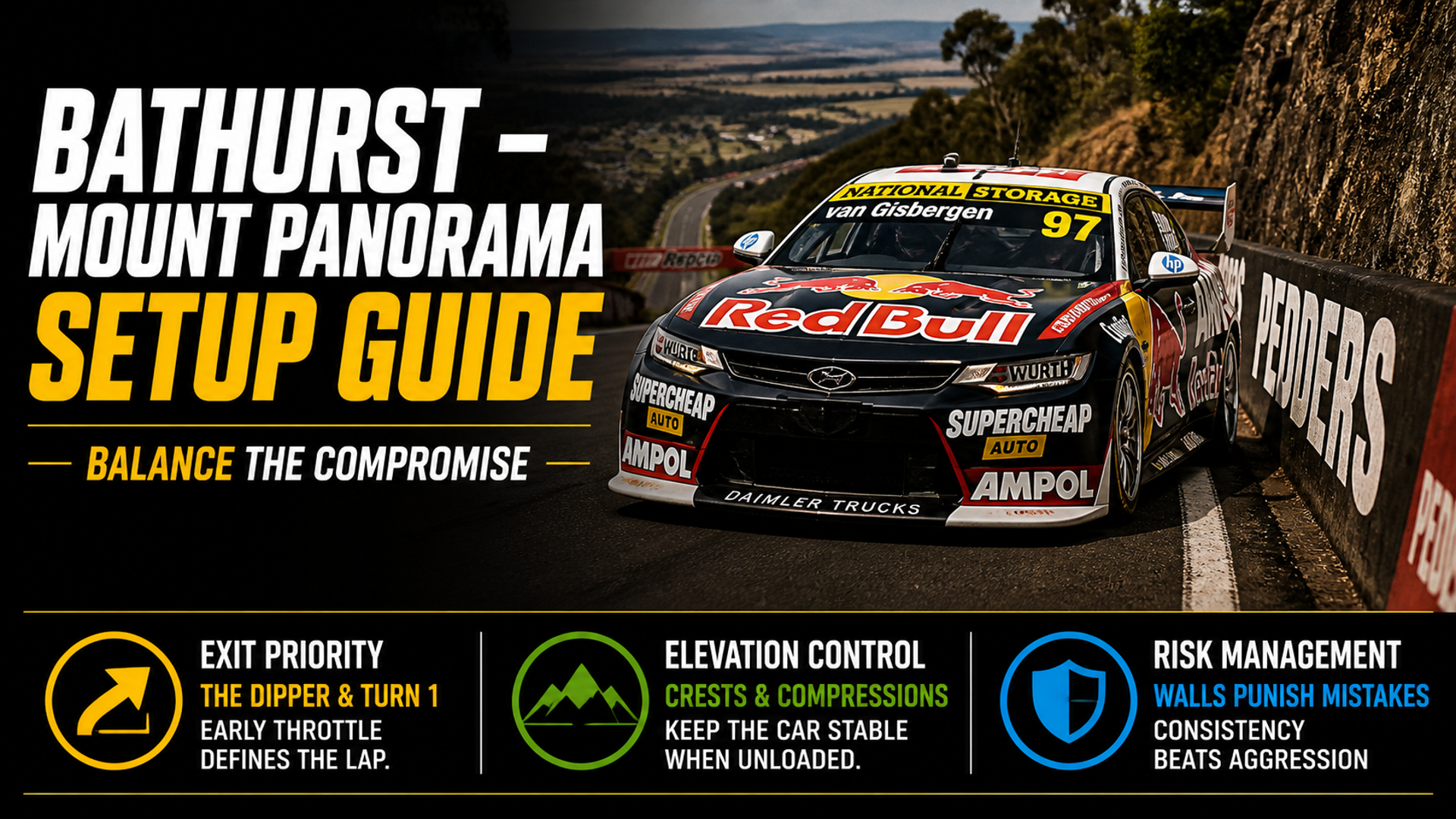
Mount Panorama Circuit is not a track to approach casually. It is long, fast, and unforgiving, with massive elevation changes, heavy braking zones, and walls that are always waiting for even the smallest mistake. The car is constantly being loaded, unloaded, and transitioned in ways that few other tracks demand. The only places where a driver can momentarily relax are the straights, and those same sections are where your competitors will be looking to attack.
This creates a unique challenge. The car must be fast on the straights, stable under braking, compliant over crests and compressions, and responsive through rapid direction changes. Many of these demands conflict with one another, which means the setup becomes an exercise in compromise. The goal is not perfection in any one area, but balance across all of them.
Starting Setup — Build for Conflict
A low downforce setup is essential to remain competitive on the long straights, even though it will reduce comfort and confidence in the corners. The car must also be capable of rapid left-to-right transitions through the Esses, settling quickly on its suspension before each direction change. At the same time, it must be able to handle three major braking zones and maintain traction while climbing steep gradients under load.
Aerodynamics — How Low Is Low Enough?
Reducing aerodynamic drag is the easiest way to gain speed, but it must be done carefully. At Bathurst, only a small number of corners rely heavily on aerodynamic grip, most notably Turn 20 and, to a lesser extent, Turn 19 (Forrest’s Elbow). These corners define the lower limit of your aero setup.
The objective is to run the lowest possible downforce while still being able to navigate these corners safely at maximum speed. If the car becomes unstable or requires lifting where it should not, too much downforce has been removed. Once the aero is set, the rest of the car must be rebalanced around it using springs, anti-roll bars, and other mechanical adjustments.
Priority Corners — Where Lap Time Is Won
 As with any circuit, the most important corners are those that lead onto the longest straights. At Bathurst, this begins with Turn 18, known as The Dipper.
Priority Corner #1 — The Dipper (Turn 18)
The Dipper leads onto the longest straight on the track, making it the most critical corner for both lap time and race position. Entry is compromised by the preceding Esses, so the focus shifts to achieving a clean rotation and precise apex.
The car must be able to turn in and reach the inside wall without hesitation. This is primarily an entry balance problem, where toe, caster, dampers, and differential settings all contribute to how effectively the car rotates. Once the apex is achieved, attention shifts immediately to exit.
The goal is to apply throttle earlier than your competitors and maintain it without the car pushing wide into the outside wall. This requires careful control of both front grip and rear stability, with dampers and differential settings playing a key role. A strong exit from The Dipper provides an advantage all the way down the straight and creates both defensive and offensive opportunities.
Priority Corner #2 — Hell Corner (Turn 1)
Turn 1 leads onto the next longest straight and shares many characteristics with The Dipper. Fortunately, both are left-hand corners, meaning that adjustments made for one will often benefit the other.
Exit is again the priority. If a compromise must be made, it should favor exit over entry. A clean apex followed by early and confident throttle application will generate more speed down the straight than an aggressive entry ever could.
Priority Corner #3 — Murray’s Corner (Final Turn)
The final corner leads onto the main straight and is the last major opportunity to influence lap time. Unlike the previous priority corners, entry here is just as important as exit due to its role as a primary passing zone. The setup must strike a balance between stability under braking and strong acceleration on exit. The straight is shorter than the others, so maximizing both phases of the corner is necessary to remain competitive.
The Additional Gains — Where Time Is Hidden
By this stage, the car should be competitive and capable of consistent laps. Further improvements come from addressing specific sections of the track that, while not as obvious, still offer meaningful gains.
Turn 2 is one of the few passing zones and is less about gaining time and more about minimizing loss. A strong entry allows you to pass slower cars under braking, avoiding being held up through the mountain section. Trail braking can be particularly effective here, but must be used carefully due to the off-camber exit.
The climb through Turns 3 to 8 introduces a unique challenge in the form of elevation. Every lift of the throttle not only reduces acceleration but allows gravity to slow the car more rapidly than on flat sections. Maintaining momentum becomes critical.
This is achieved through smooth and deliberate inputs, combined with intelligent gear selection. Shifting at moments when the throttle would naturally be reduced avoids unnecessary interruptions in acceleration. These small decisions compound over the course of the climb and can significantly impact overall performance.
onRails Is Here
If you found this guide useful, you’ll want to know about our next-generation setup app: onRails — Setup Creation and Engineering Suite. It combines and replaces both the Setup Developer Tool and Virtual Race Car Engineer into a single redesigned app that runs as a transparent overlay on top of your sim. Includes a live SimReader for nine supported simulators and a brand-new In-Race Engineer for real-time pit-call advice.
Available now on Steam & Itch.io.
Managing Elevation and Transitions
Bathurst is defined by its elevation changes, and how the car handles crests and compressions can determine both lap time and confidence. At points such as the exit of Turn 9 and the approach to Skyline, the car becomes light, reducing tire contact and increasing the risk of instability.
Damper settings play a critical role here. Reducing rear rebound damping allows the suspension to extend more quickly, helping the tires maintain contact with the surface. This can reduce the need to lift off the throttle and improve stability during these transitions.
However, these adjustments affect other areas of the track, particularly braking zones. As with all setup changes, they must be balanced against their broader impact.
The Chase — Sacrifice for Position
The Chase chicane presents an opportunity to gain or defend position through strategic compromise. By sacrificing the exit of the first corner in the chicane, the car can be better positioned for the second, which leads directly into a braking zone and passing opportunity.
Focusing on early throttle application through the second part of the chicane allows for stronger acceleration and improved positioning. Dampers and differential settings can be used to support this behavior, ensuring that the car remains stable under power.
Risk vs Reward — The Esses
The Esses are one of the most visually dramatic sections of the track, but they are not where races are won. While it is possible to gain small amounts of time by pushing aggressively through this section, the risk of making a mistake is high, and the consequences are severe. A measured approach is often more effective. Maintaining control and consistency through the Esses allows you to capitalize on the mistakes of others, rather than risking your own race for minimal gain.
At Bathurst, performance comes from managing compromise. Build a setup that balances straight-line speed with stability over elevation changes and rapid transitions. Focus on maximizing exit from key corners, maintaining momentum through the mountain, and using setup and driving strategy together. Precision and control will deliver more performance than aggression alone.
You can find more setup guides here
Discover more from Virtual Race Car Engineer
Subscribe to get the latest posts sent to your email.